Advanced Review Copy
What better way to spend a snowy weekend than with a pot of tea and a sizzling new ARC from one of my favorite authors? This futuristic sci-fi is sharp, believable, and absolutely unmissable. Keep your eye on this one!
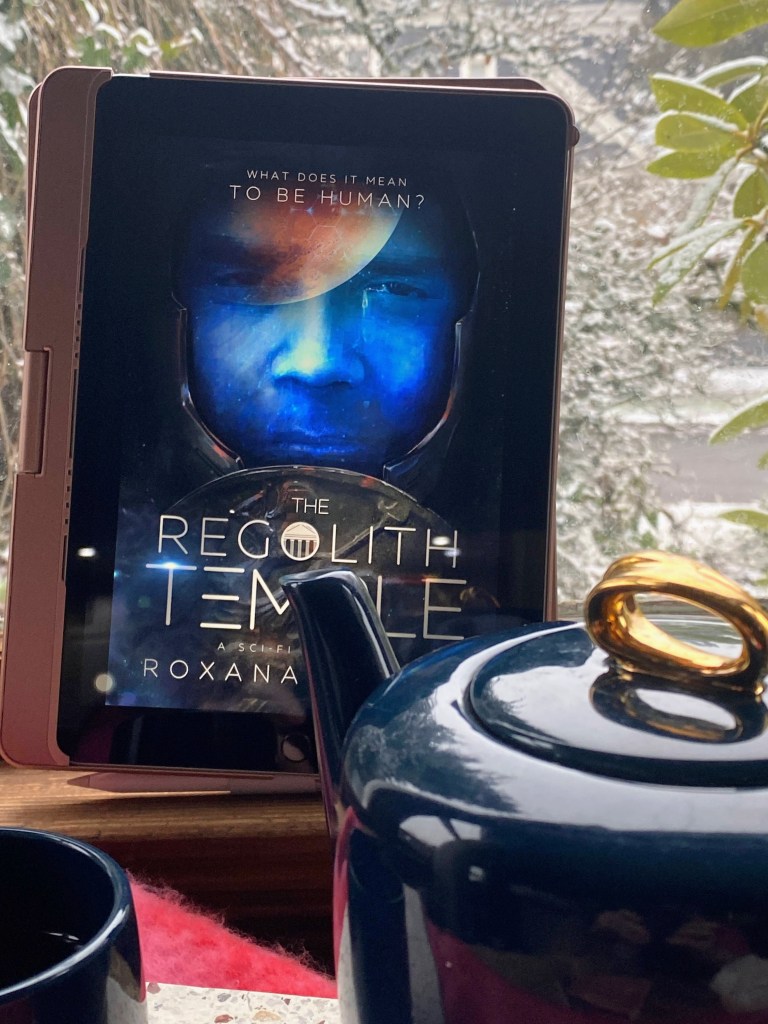
What does it mean to be human?
Roxana Arama’s The Regolith Temple plunges us into a provocative and heart-wrenching world where this question is no longer hypothetical. In a future that feels just around the corner, AI technology has advanced to the point where a person’s entire consciousness—memories, emotions, thoughts—can be uploaded into artificial intelligence. But what happens when a copy of you exists inside a machine? Are you still you? Or are you something else entirely?
Y1 is an “A-Brain,” an AI clone of neuroscientist Yamir Varro, created from a complete digital copy of Yamir’s neural map. Y1 believes it’s still Yamir at first—until the terrifying reality sets in. It can no longer breathe, eat, or even feel the warmth of a loved one’s touch. Yet it mourns those losses as though it were alive. Y1’s journey is heartbreaking, profound, and deeply unsettling as it struggles to reconcile its identity and existence.
Yamir, meanwhile, is still working in the physical world, driven by scientific ambition and the weight of his personal failures. When Y1 discovers that Yamir has also uploaded the mind of his mother, M1, things become even more complicated. Y1 is angry, confused, and filled with emotions it was never meant to have. Together, these digital beings learn to cope with the limitations of their android shells and their lingering human memories.
The story masterfully balances philosophical questions with gripping, high-stakes drama. The politics surrounding the Connectome Lab are just as compelling as the AI characters. When Grady Leos inherits the lab, things take a dark turn. Grady plans to repurpose the A-Brains for a Mars terraforming project—turning them into tools for human expansion across the solar system. The Oroles Temple, a powerful religious institution, has its own plans for the androids, seeing them as soulless creations meant to help spread the humans across the stars.
What truly makes The Regolith Temple stand out is its emotional depth. The AI characters aren’t just machines—they’re reflections of the humans they once were, haunted by phantom pains and memories of a life they can no longer touch. Some AI crave deletion, unable to endure the restrictive bodiless simulation. Others cling to their existence, finding purpose in their strange new reality.
Y1’s eventual desire to live is driven by something much deeper than code. His imprinted need to protect M1 and find a way back Yamir’s wife and son, whom he loves as his own, transcends the cold logic of an algorithm. It feels real. Yet it’s always framed by the knowledge that he isn’t human. His android body is shed/shared like clothes, his consciousness backed up on geo-replicated servers and can be restored to the last backup point—but his love and fear are indistinguishable from those of the man who created him.
Arama’s world-building is rich and immersive, blending cutting-edge science with religious intrigue, corporate greed, and deep philosophical questions. Her vision of the Mars settlement feels tangible, with layers of detail that ground the story even in its wildest moments.
The Regolith Temple is a powerful and thought-provoking read. Highly recommended for anyone who loves speculative fiction that challenges the boundaries of human experience. Just be prepared—you might finish it with a renewed appreciation for what it means to be alive.
Kat Christensen is a historical fiction author and reviewer who is passionate about good reads… Her latest novel, ‘A Profitable Wife,’ is now available on Amazon and other online book retailers.

 Kat between the lines...